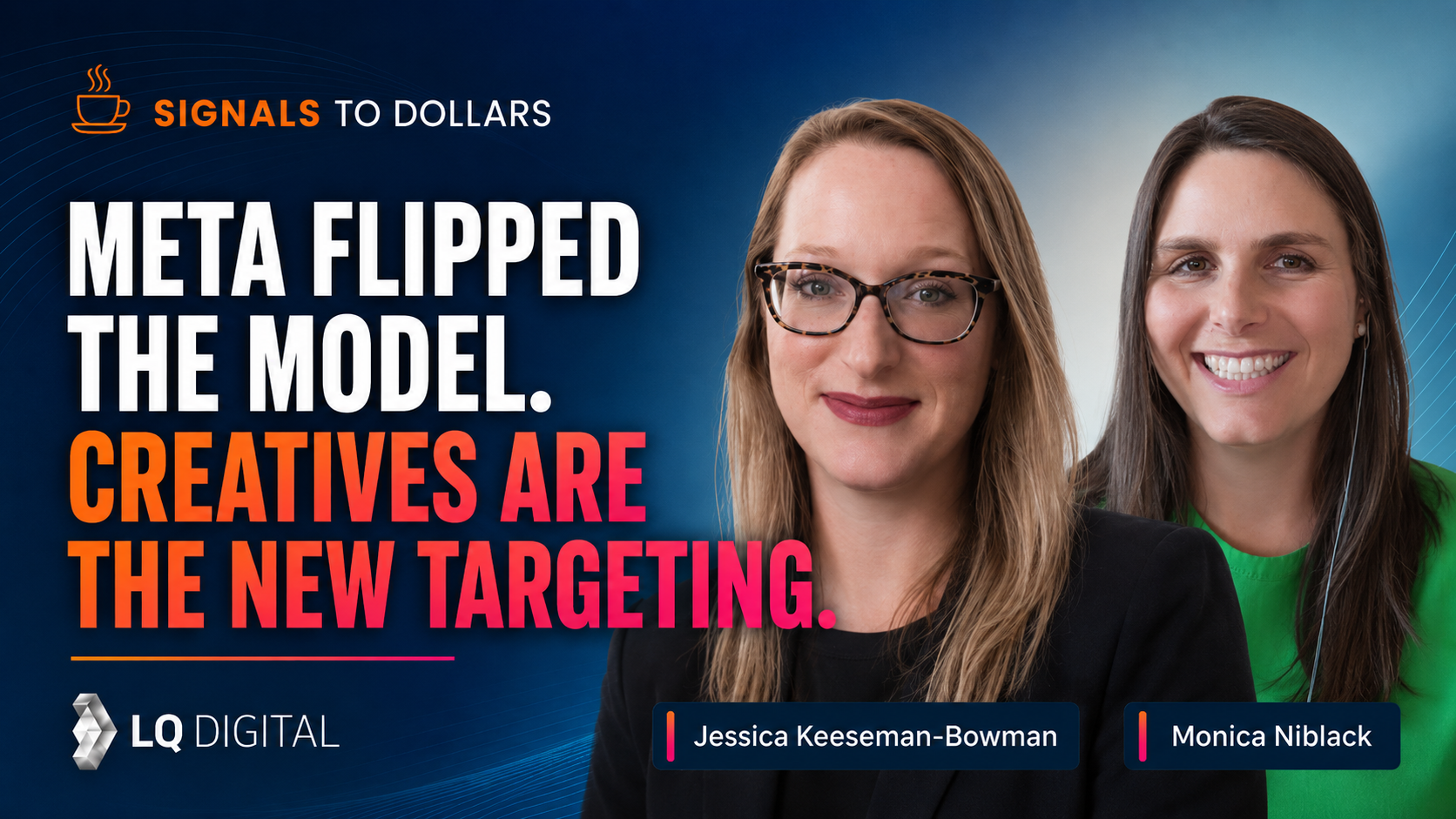
Jessica and Monica discussed in this coffee chat how a few years ago, Meta campaigns were built around audience precision. Find the right people, show them variations, see what works.Understanding and correctly defining your audience was one of your most important levers. That's not how it works anymore.
Meta's Advantage+ has effectively reduced audience targeting to a light suggestion at best. The algorithm decides who is your audience and who sees your ad. Removed from audience targeting, creative has become the primary targeting mechanism, the messaging and visuals you choose are how Meta figures out which audience is the best fit for your brand.
In practice, this means the old approach of testing five variations of the same concept with different background colors is dead. Meta actively penalizes ads that are too similar. You need genuinely differentiated creative, different pain points, different angles, different concepts entirely. This puts an additional workload on the creative team, which, understandably, is relaying on AI to do more work with the same resources.
Every week we talk to marketers who are excited about what AI can do for their creative production. They're not wrong to be excited. But there's a distinction most people are glossing over and it's costing some of them real brand equity. AI can make creative faster, it cannot make creative better, particularly not on its own.
That gap is where brands are getting themselves into trouble.
Here are the main topics we touched in the coffee chat:
The right use of AI in creative: front end, not final.
We use AI extensively at LQ for concepting. What used to take days, now takes a fraction of the time. We feed client data, audience research, and what we know about buyer pain points into tools to generate early-stage creative directions, we use LQ Insights to pull audience research. We can feed AI extensive data on the client and audience to build smarter creative briefs, faster.
However, we don’t (and advise you don’t either) take that output and ship it to paid media. Everything goes through human review. Everything goes through our design partners before it touches a live campaign.
Why is that? Not because AI can't produce something convincing, it absolutely can nowadays, but because convincing and brand-safe are not the same thing.
REI found out the hard way. They got automatically enrolled in Meta's generative ad features. The result: bikes with two handlebars. True Classic has dealt with similar issues. The creative looks almost right, until it doesn't, and then your comment section becomes your brand's new address.
For brands in healthcare or financial services, the stakes are even higher. A visual that looks a little off isn't just embarrassing. It's a compliance issue.
The trust gap most marketers are missing.
Here's a number worth sitting with: roughly 83% of marketers believe AI creative won't hurt brand trust. Less than half of consumers agree.
Marketers inside the AI excitement cycle tend to assume the outside world is keeping up. It's not. Marketers think younger consumers would be the first ones to adopt changes, however, younger consumers are the most skeptical, and those are the same people moving into business decision-making roles at the companies we're trying to reach.
AI-generated content is increasingly easy to spot, particularly to a tech savvy audience. People scroll past it, identify it immediately, and say so, out loud and in the comments. "AI slop" isn't a hypothetical risk. It's happening right now on every major platform. LinkedIn, Meta, YouTube. Scroll far enough and you'll find it.
The brands that don't account for this are going to have a harder time walking back the damage than they expect.
The actual mistake brands are making.
AI makes it genuinely easy to produce high creative volume, which could be helpful to the overworked designed team. However, there needs to be a strategy behind those creatives, particularly if they will be your main source of audience targeting.
If your creative team is handing off assets without a clear testing framework, which hypothesis are we proving, which pain points are we isolating, what will we actually know when this test is over, then Creative A outperforming Creative B is nearly meaningless. You don't know why. You can't build on it. You end up occasionally stumbling into a winner and having no idea how to repeat it.
The feedback loop between creative and media has to be tight. The brief has to exist before the asset does. When those two functions operate in silos, you run fast but in circles.
What actually works.
The brands getting this right are using AI as a force multiplier on the front end: ideation, research, concepting, iteration. However, they hold human judgment accountable for everything that goes to market.
They're also building intentional test-and-learn frameworks instead of just producing more. Each creative serves a hypothesis, each result advances the roadmap. That allows them to get smarter, faster and in a direction that actually matters.
You still need a brief, you still need the methodology and human judgement to decide when a creative isn’t right for your brand. AI isn't replacing the fundamentals.With strong fundamentals, it can accelerate the testing and the production. But if you lack strong fundamentals it will just l help you fail faster.